5 Steps to a Fully Trained Off-Leash Puppy
May 08, 2026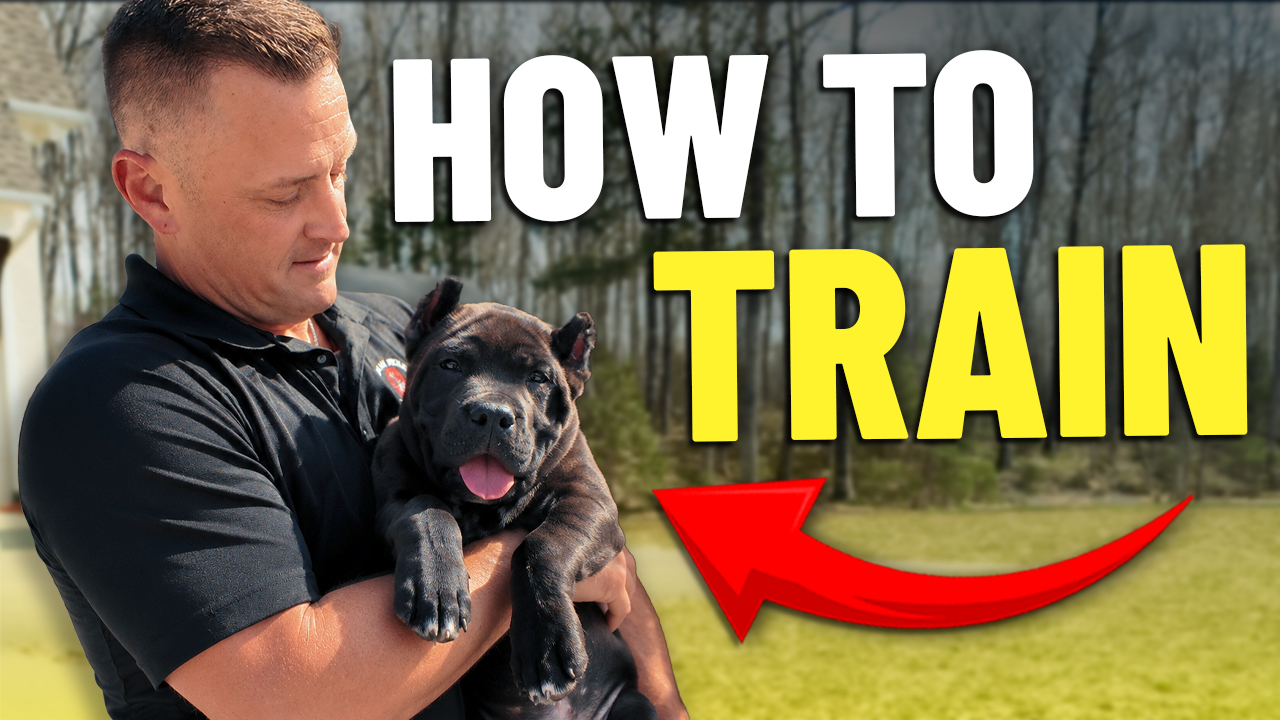
Learn the step-by-step training system used to build real-world obedience and off-leash reliability—even in a young 4½-month-old puppy.
Intro
Most people think reliable off-leash obedience takes years to achieve. The truth is, with the right training system, a young puppy can develop incredible focus, confidence, and reliability long before adulthood. In this article, you'll learn the five foundational steps used to transform a 4½-month-old Cane Corso into a puppy capable of performing advanced obedience in busy public environments.
Key Takeaways
- Food luring creates the foundation for teaching every major obedience command.
- Leash pressure builds reliability when food alone isn't enough.
- Confidence training helps puppies overcome fear of unfamiliar surfaces and environments.
- Properly conditioned e-collar training creates safe and dependable off-leash freedom.
- Real obedience means your dog performs even around distractions—not just in your living room.
- Training should build trust, confidence, and clarity—not fear or confusion.
Main Content
Step 1: Build Everything on Food Luring
Every great training program starts with motivation.
Food luring is one of the fastest ways to teach a puppy new behaviors because food naturally draws the dog's attention. Think of the food as a magnet and your puppy's nose as the other magnet. Wherever the food goes, the puppy follows.
Using this simple concept, you can teach:
- Sit
- Down
- Front
- Heel position
- Loose leash walking
- Recall
The best place to begin isn't a busy park—it's your kitchen, living room, backyard, or another low-distraction environment where your puppy can focus and succeed.
Food creates understanding first. Reliability comes later.
Step 2: Use Leash Pressure to Create Reliability
Food is an excellent teacher.
The leash is what makes the behavior dependable.
Every dog eventually encounters distractions that are more exciting than a treat—another dog, wildlife, visitors, or unfamiliar environments. That's why leash communication is so important.
Proper leash pressure teaches the dog how to respond to guidance rather than fight against it.
The key is introducing leash pressure gradually. Light, consistent pressure helps the puppy understand how to move with the leash instead of resisting it.
When taught correctly, the leash becomes a communication tool—not a punishment.
Step 3: Build Confidence Through New Experiences
Confident dogs aren't born—they're developed.
Introducing puppies to unfamiliar objects, unstable surfaces, and new environments helps prepare them for everyday life.
Whether it's:
- A shopping cart
- An elevator
- A veterinary table
- A moving platform
- A vehicle
…the goal is to teach the puppy that uncertainty doesn't mean danger.
By combining calm leash guidance with positive reinforcement, puppies learn to work through hesitation instead of avoiding new situations.
Confidence training creates dogs that can confidently navigate the real world.
Step 4: Understand Opposition Reflex
One of the biggest reasons dogs pull on the leash is something called opposition reflex.
When pressure is applied in one direction, many dogs instinctively pull in the opposite direction.
That's why simply dragging or pulling your dog often creates more resistance instead of cooperation.
Rather than fighting the dog, effective trainers teach puppies how to follow leash pressure from the beginning.
Once a dog understands that pressure has meaning, leash walking becomes dramatically smoother, and everyday handling becomes much easier.
Step 5: Transition to Reliable Off-Leash Freedom
Off-leash freedom isn't about removing the leash.
It's about replacing it with another form of communication.
A properly conditioned e-collar allows the dog to understand commands at a distance while maintaining the same clarity they learned on leash.
The e-collar should never be introduced randomly or used without proper conditioning. When introduced correctly, it simply becomes another communication tool that reinforces already-understood behaviors.
This allows dogs to perform reliably with commands like:
- Recall
- Sit
- Down
- Heel
- Place
- Stay
—even when distractions are present.
Proof Comes in Public
Training only counts if it works outside your home.
During this session, the young Cane Corso demonstrated:
- Off-leash heel work
- Reliable recalls
- Down-in-motion exercises
- Long-distance down stays
- Ignoring people and other dogs
- Maintaining position despite heavy public distractions
Perhaps most impressively, the puppy held a long down stay while the handler walked completely out of sight before returning.
This level of obedience doesn't happen by accident.
It comes from layering motivation, leash communication, confidence building, and proper off-leash conditioning into one complete training system.
Great Training Builds Trust
One of the biggest misconceptions about advanced obedience is that it requires harsh corrections.
In reality, effective training should create a dog that enjoys working.
Throughout the session, the puppy remained engaged, confident, enthusiastic, and eager to continue learning.
The goal isn't to intimidate the dog into obedience.
The goal is to build a dog that clearly understands expectations and confidently succeeds in almost any environment.
Final Thoughts
Every puppy has the potential to become a calm, confident, reliable companion.
The difference isn't genetics alone—it's having a structured training system that develops each skill in the right order.
Start with motivation, build reliability through clear communication, expose your puppy to new experiences, and gradually earn the privilege of true off-leash freedom.
Done correctly, you'll have a dog that listens because it understands—not because it has to.
Call To Action
Want to build this same level of obedience with your own dog? Our complete training system walks you through each stage, from foundational puppy skills to advanced off-leash reliability.
👉 [LINK TO MAIN OFFER]


 EXPLORE OUR COURSES
 DIYK9 MEMBERSHIPS
 TRAINING TOOLS